How to Prepare a Payload for an In-Orbit Demonstration Mission
Learn the satellite payload requirements for an IOD mission, including interfaces, testing evidence, operations, licensing and integration readiness.
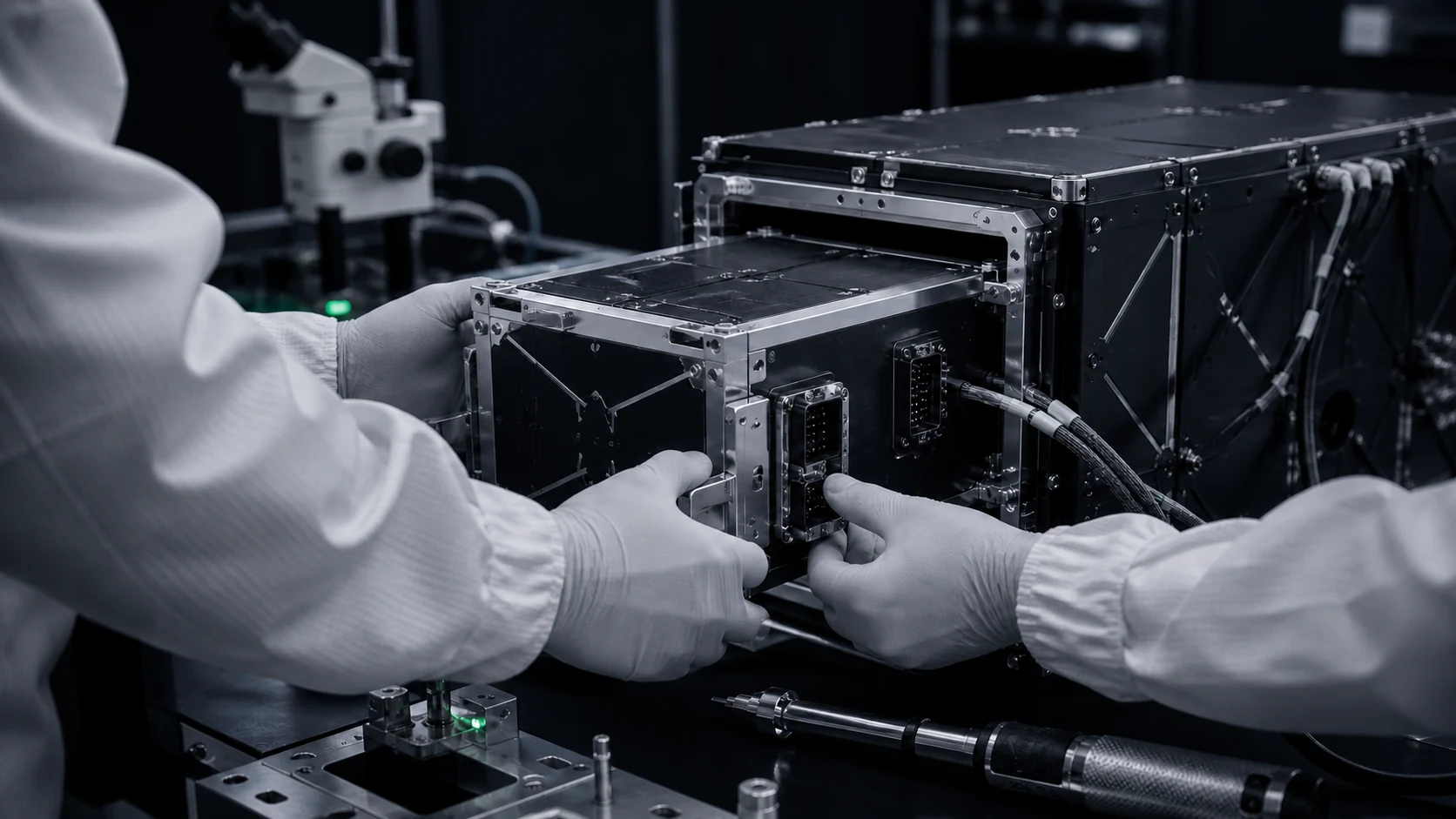
A payload is ready for an in-orbit demonstration when its purpose, interfaces, evidence, risks and operating concept are clear enough for a mission team to assess it and integrate it. That does not mean every test is finished or every drawing is frozen, it means the remaining work is visible and the demonstration has a measurable job to do.
The exact requirements depend on the spacecraft, launch environment, orbit and mission duration, so a useful readiness guide should not hand every team the same vibration level, thermal range or connector. It should help you arrive at the first technical discussion with the information needed to make good decisions.
This guide covers that preparation, from the question your demonstration must answer through to interfaces, verification, documentation and operations.
IOD Payload Readiness at a Glance
| Area | What should be clear |
|---|---|
| Demonstration goal | The uncertainty being tested and the evidence needed to resolve it |
| Configuration | Which hardware, firmware and software version will fly |
| Interfaces | Mass, geometry, mounting, power, thermal behaviour, data and communications |
| Verification | What has been tested, against which requirement, and what remains open |
| Safety and regulation | Materials, stored energy, pressure, RF, export-control and licensing questions |
| Operations | Modes, commands, telemetry, duty cycle, fault responses and data delivery |
If one of these areas is still unknown, that is not automatically a rejection. Unknowns become expensive when they stay hidden until the combined spacecraft is already being designed or tested.
1. Define What the Mission Must Prove
Start with the decision that will be made after the flight. A demonstration described only as “prove it works in space” is too broad to design well and difficult to defend later.
A useful objective connects four things:
- The capability: what the technology is meant to do.
- The relevant environment: the orbit, exposure, operating mode or platform condition that matters.
- The measurement: the telemetry, output or observation that shows performance.
- The acceptance threshold: the result that counts as success, partial success or failure.
For a sensor, that might mean measuring accuracy and stability across defined thermal conditions. For onboard software, it might mean latency, inference performance, resource use and fault recovery on the target compute environment. For a propulsion component, the evidence may involve repeatable operation, measured performance and the effect on the rest of the spacecraft.
The result is a validation question that can be traced into requirements, operations and the post-flight report. It also keeps the mission honest: a successful launch is not automatically a successful demonstration.
2. Establish the Payload Baseline
The mission team needs to know what is being assessed. Create a configuration baseline early, even if later revisions are expected, and record the version of every item that affects fit or performance.
At minimum, document:
- overall dimensions, keep-out zones, mass and centre of gravity;
- mounting points, fasteners, stiffness and any deployable or moving parts;
- input voltage range, peak and average power, inrush current and duty cycle;
- operating and survival temperatures, heat dissipation and preferred thermal path;
- command, telemetry and data interfaces, including protocol and connector assumptions;
- data generated per operating cycle and the time sensitivity of delivery;
- pointing, stability, field-of-view or alignment needs;
- radios, antennas or other intentional emitters;
- batteries, pressure vessels, pyrotechnics, stored energy and hazardous materials;
- materials, coatings, adhesives and contamination-sensitive surfaces;
- firmware, onboard software, dependencies and update method.
These are inputs, not final interface commitments. The agreed interface is developed with the mission team and captured through formal configuration control.
3. Write the Concept of Operations Early
The Concept of Operations, usually shortened to ConOps, explains how the payload behaves from integration through end of mission. It connects the hardware, software and spacecraft assumptions that are easy to miss when teams work in separate documents.
A practical payload ConOps should cover:
- launch and early-orbit state;
- power-on, commissioning and calibration;
- normal operating modes and duty cycles;
- command sequences and timing constraints;
- telemetry needed to confirm health and performance;
- data generation, storage, prioritisation and delivery;
- safe mode and recovery behaviour;
- interactions with attitude, power, thermal and communications subsystems;
- planned software or parameter updates;
- end-of-demonstration and passivation behaviour where relevant.
Write the first version before design freeze. A rough ConOps exposes assumptions early, while a late ConOps often documents decisions the spacecraft team has already been forced to make without you.
4. Prepare the Interface Data
The Interface Control Document, or ICD, becomes the controlled agreement between payload and spacecraft. You do not need a finished ICD before the first conversation, but you should have enough data to begin one.
| Interface | Useful first inputs |
|---|---|
| Mechanical | Envelope, mass, centre of gravity, mounting concept, keep-outs, access needs |
| Electrical | Voltage range, current profile, inrush, grounding, connectors, protection |
| Thermal | Operating and survival limits, dissipation by mode, thermal contact assumptions |
| Data | Protocol, packet or message definition, throughput, storage and latency needs |
| RF | Frequency, bandwidth, power, antenna pattern, operating location and duty cycle |
| Operational | Modes, commands, telemetry, timing, autonomy and failure responses |
Treat every number as a configuration-controlled statement. If the payload team changes a connector, power profile or software mode after interface sign-off, the combined system may need new analysis or testing, so the change needs to be assessed before it reaches the flight unit.
5. Build a Mission-Specific Verification Plan
Space projects use established testing standards, but the standards do not give every payload one universal campaign. ECSS-E-ST-10-03C covers qualification, acceptance and protoflight testing, while NASA’s General Environmental Verification Standard provides baseline methods and guideline levels for GSFC projects. Both frameworks expect projects to derive requirements from the expected mission environment and verification approach.
Your campaign may include:
- functional and performance testing;
- vibration and shock testing derived from the launch environment;
- thermal-vacuum and thermal-cycling tests derived from mission limits;
- electromagnetic compatibility and electromagnetic interference testing;
- radiation analysis or testing appropriate to the electronics and mission;
- materials and outgassing assessment;
- software, fault-management and end-to-end data-flow testing;
- deployment, mechanism or life testing where the design needs it.
For materials, NASA maintains a public outgassing database that can help with early selection, although acceptance still depends on the mission’s contamination-control requirements.
For every test, record the requirement, article tested, configuration, procedure, result, anomaly and closure. A certificate that says “passed” carries less value than a traceable report showing what was tested and how it maps to the flight configuration.
6. Assemble the Evidence Package
The first useful package is smaller than a final delivery set, but it should let the mission team understand the current maturity and the work still required.
Prepare:
- payload description and demonstration objectives;
- preliminary requirements and interface data;
- current ConOps;
- mechanical drawings and configuration list;
- power, thermal and data budgets;
- materials, hazards and stored-energy information;
- test plans and completed test reports;
- software and firmware version records;
- verification matrix or requirements traceability table;
- known anomalies, waivers, deviations and open decisions;
- RF, licensing and export-control status where relevant.
Do not hide failed tests or anomalies. A well-documented failure with a clear root cause and verified fix is easier to integrate than an unexplained gap discovered during combined testing.
7. Clarify Regulatory and Commercial Responsibilities
Licensing responsibility cannot be assigned by a generic checklist. It depends on who procures launch, who operates the spacecraft, where those activities are carried out, what the payload transmits and which jurisdictions apply.
For UK missions, the Civil Aviation Authority explains that an orbital operator licence can cover procuring launch and operating a space object, and that separate entities may need separate licences when those responsibilities are split. Spectrum is a separate track: Ofcom manages UK satellite filings and submissions to the ITU, while international coordination depends on the network and affected administrations.
Raise these points before design freeze:
- whether the payload intentionally transmits RF;
- where payload and mission operations will be controlled;
- who owns the frequency filing and coordination work;
- who procures launch and who operates the spacecraft;
- whether technical data crosses borders;
- whether the payload contains controlled or restricted components;
- what evidence each party must provide for the mission licence and safety case.
The final allocation belongs in the mission agreement and regulatory plan, not in assumptions passed between engineering teams.
Common Readiness Gaps
Success criteria that cannot be measured
If the required evidence is not defined, the mission may collect plenty of telemetry without answering the commercial or technical question that justified the flight.
Interfaces based on nominal values only
Average power, typical data rate and nominal temperature are not enough. Integration needs peaks, transients, tolerances, survival limits and behaviour during faults.
A changing payload with no configuration record
Late changes happen, but undocumented late changes break traceability. Keep hardware, firmware, software and test evidence tied to a clear version.
Testing copied from another mission
A previous campaign is useful evidence, but the new launch environment, orbit, mounting, duration or operating mode may create additional work. Compare the conditions before claiming inheritance.
Licensing discussed after the design is frozen
RF choices, operating locations and cross-border technical exchange can affect the schedule and architecture. Surface them while there is still room to change the plan.
Payload Readiness Checklist
Before a mission-fit discussion, you should be able to share or explain:
- the capability and the decision the demonstration must support;
- measurable success, partial-success and failure criteria;
- payload mass, geometry, centre of gravity and mounting assumptions;
- power profile by mode, including peaks and duty cycle;
- operating and survival temperatures plus heat dissipation;
- command, telemetry and data interfaces;
- data volume, storage and delivery needs;
- preliminary ConOps and fault responses;
- current hardware, firmware and software configuration;
- completed tests, applicable standards and remaining gaps;
- materials, hazards, stored energy and contamination concerns;
- RF, licensing and export-control questions;
- the evidence package expected after flight.
Where SATELYX Fits
SATELYX is an Agile Prime for responsive space: we factor space technology into shared missions, manage the mission around a defined validation campaign, and turn successful results into documented flight-proven capability with a path to reuse.
The work starts with fit. We assess what the technology must prove, which environment matters, what interfaces and evidence already exist, and which gaps need to close before integration. The mission then produces performance data, telemetry, configuration records and a post-flight evidence package that can support future technical and commercial evaluations.
Reuse still depends on the next mission’s configuration and environment, so flight heritage is never treated as a blanket exemption from engineering. Customer payload data, intellectual property and reuse rights remain governed by the relevant agreement. The value is a stronger starting point: known behaviour, traceable evidence and interfaces that have been exercised together.
For the wider context, read our guides to in-orbit demonstration and flight heritage, or review the mission FAQ.
If your space technology is approaching flight readiness, request a mission review.
Frequently Asked Questions
What TRL should a payload reach before an IOD mission?
Does environmental testing need to be complete before the first mission discussion?
What documents should a payload team prepare first?
Who handles licensing and spectrum for an IOD payload?
When should a payload team contact SATELYX?
Does Your Space Technology Need Flight Evidence?
Start with a mission-fit review for the software or hardware you need to prove in orbit.
Request a mission review