VLEO: What Very Low Earth Orbit Changes
Very Low Earth Orbit can improve sensing and communications, but drag, atomic oxygen and short lifetimes change satellite design and operations.
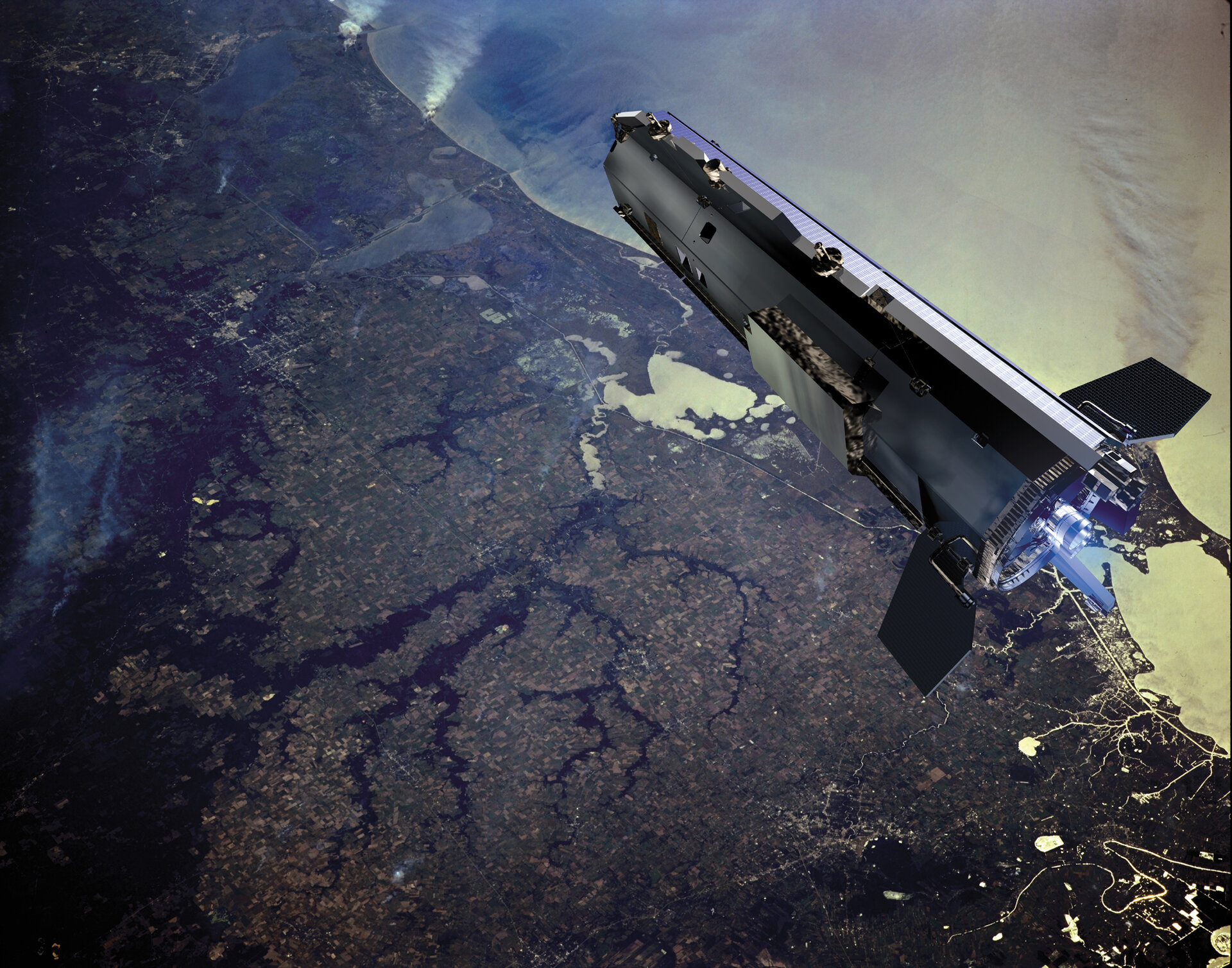
Very Low Earth Orbit, usually shortened to VLEO, is the region where the remaining atmosphere has a major effect on spacecraft design and operations. Definitions vary, but the European Space Agency describes VLEO as roughly 100 to 450 kilometres above Earth.
The attraction is proximity. A spacecraft closer to Earth can achieve a given observation or communications objective with different sensor, antenna and link-budget choices than a spacecraft operating higher up. The cost is a harsher environment and a continuous fight against drag.
Why missions consider VLEO
For Earth observation, lower altitude can improve ground resolution for the same optical system, or let a mission target the same resolution with a smaller instrument. Communications missions can benefit from lower propagation delay and reduced path loss.
VLEO also has a natural end-of-life advantage. Atmospheric drag removes an unpropelled spacecraft from orbit much faster than it would at higher LEO altitudes. The exact lifetime depends on altitude, spacecraft shape, mass, attitude and solar activity, so it should be analysed for the specific mission rather than reduced to a universal number.
These benefits are not free. The environment shapes almost every subsystem.
Drag and propulsion
Atmospheric drag slows a VLEO spacecraft and causes its orbit to decay. A sustained mission therefore needs a design that reduces drag, a propulsion system that can restore lost energy, or both.
ESA’s GOCE satellite is a useful operational example. GOCE used a streamlined spacecraft body and ion propulsion to counter atmospheric drag while mapping Earth’s gravity field. It showed that long-duration operation at very low altitude is possible when the spacecraft is designed around that environment.
Propulsion performance, propellant supply, spacecraft aerodynamics and autonomous orbit control are connected design choices. A change in one can alter mission lifetime, power demand and the operating plan.
Atomic oxygen and materials
At VLEO altitudes, atomic oxygen can erode polymers, coatings and exposed surfaces. Solar arrays, thermal-control materials, optical surfaces and harnessing may all need material selection, protection and testing suited to the expected exposure.
ESA’s VLEO technology campaign studied the technologies needed for sustained VLEO operations, including aerodynamics, propulsion and materials. The central lesson is that VLEO is a system problem. A propulsion solution alone does not close material, thermal or control risks.
Thermal, power and operations
A VLEO satellite still cycles between sunlight and eclipse, while drag compensation adds recurring propulsion and power demand. Aerodynamic forces can affect attitude, and the spacecraft must manage orbital changes without compromising its payload objective.
Mission teams therefore need a coupled model of orbit, attitude, propulsion, power and thermal behaviour. Ground operations and autonomy also matter because orbit maintenance is part of routine mission activity rather than an occasional manoeuvre.
Why VLEO is useful for validation
The environment makes VLEO a demanding place to demonstrate propulsion, materials, power electronics, sensors and onboard computing. A useful validation does not claim that surviving one mission proves every later application. It records the exact configuration, exposure, operating modes and results so another mission can judge what evidence transfers.
This is the role of flight heritage: traceable performance in a relevant environment, with a clear boundary around what was tested.
VLEO Pathfinder
SATELYX is developing VLEO Pathfinder as its first SATELYX-led catalog validation mission, targeted for launch in Q4 2027. It is a standardized, multi-payload platform intended to validate selected technologies and turn successful results into documented catalog capability.
Public mission materials deliberately do not publish fixed payload allocation, orbit, power, propulsion or downlink figures. Those interfaces are controlled by the evolving technical baseline and mission-fit process. Technology teams should use the contact process to discuss the current interface and validation need rather than rely on an old public number.
Read our guides to flight heritage and payload preparation.
Does Your Space Technology Need Flight Evidence?
Start with a mission-fit review for the software or hardware you need to prove in orbit.
Request a mission review