Why SATELYX Exists
Space technology often stalls between a successful prototype and credible flight evidence. SATELYX is building repeatable mission infrastructure to close that gap.
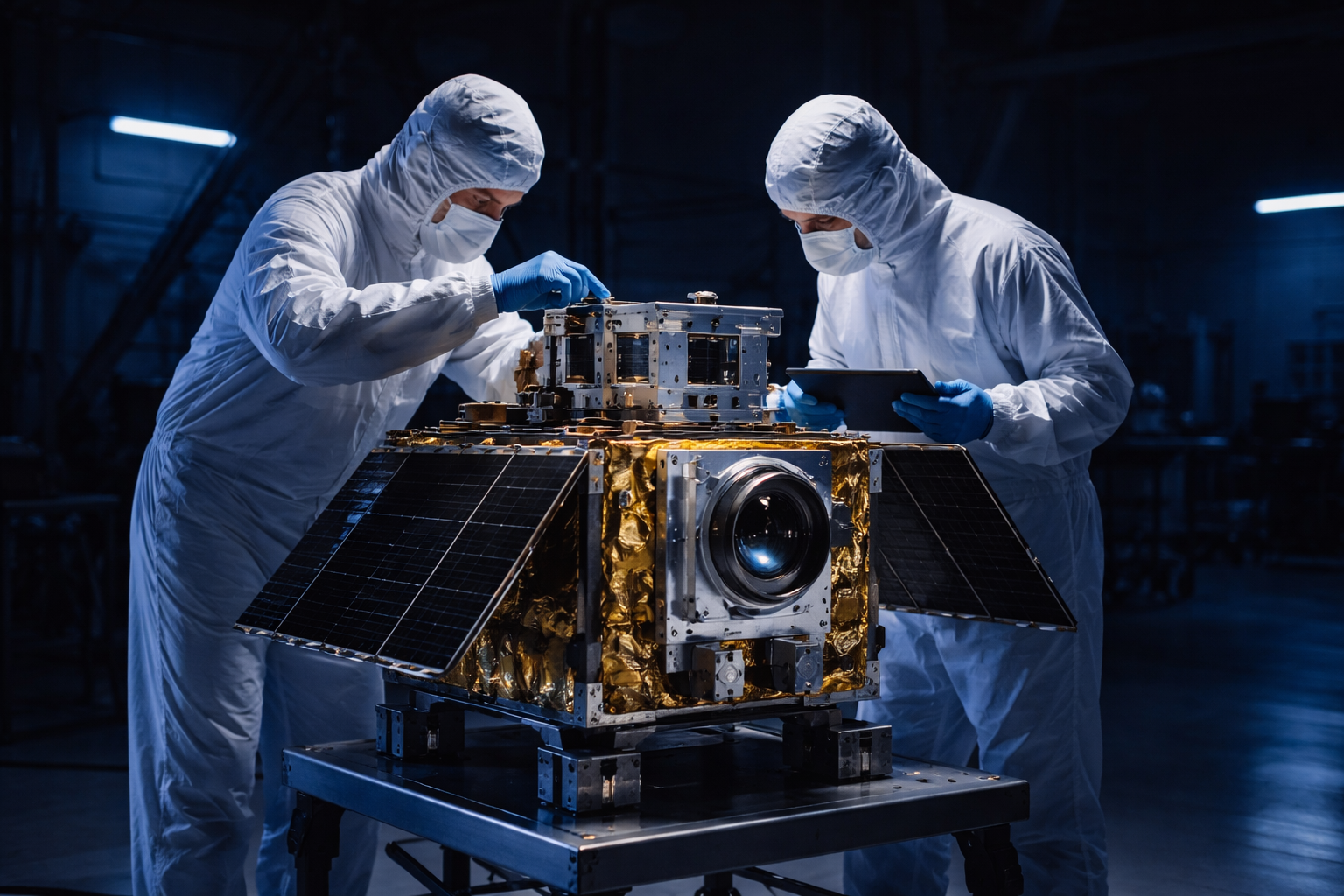
The question that started everything
Why does a team with working space technology so often need to build a satellite programme around it before anyone can see the technology perform in orbit?
We kept meeting engineers with credible sensors, propulsion systems, communications hardware and onboard software. Their next technical question was clear, but the route to answering it was fragmented. They had to find a suitable platform, negotiate interfaces, secure launch capacity, manage operations and prove the result in a form that another customer could trust.
The technology was only one part of the mission, yet its team was being asked to coordinate nearly all of it.
SATELYX exists to provide that missing mission layer.
A repeatable route to orbit
We are building repeatable infrastructure for responsive space. Through shared in-orbit demonstration missions, SATELYX factors several partners’ technologies into one mission and manages the bus, integration, operations, data delivery and launch capacity.
We call the operating model Agile Prime. An Agile Prime owns the mission outcome while partners remain focused on their own technology. Each selected payload still goes through a real mission-fit and interface process, but the partner does not have to assemble the entire mission supply chain alone.
The result we care about is more than a launch. A useful validation campaign begins with measurable objectives and ends with traceable evidence: what flew, how it operated, what the data showed and where the result applies next.
From validation to capability
Successful validation turns technology into documented, reusable capability. The configuration, interfaces, results and constraints can enter the SATELYX catalog, giving future missions a proven starting point.
That does not erase engineering or ownership boundaries. A future mission must still assess differences in environment and configuration. Customer payload data and intellectual property stay subject to the relevant agreement, and reuse of a partner’s technology requires the rights agreed with that partner. SATELYX retains the mission interfaces, telemetry and integration knowledge needed to make the platform repeatable.
The catalog becomes more useful with every mission. More validated modules create more combinations that can support future commercial and government requirements without beginning from zero.
Experience behind the model
The founding team first worked together through Singapore’s satellite programmes. It combines spacecraft engineering, mission delivery, software and commercial experience across the UK and Asia-Pacific.
Mission 0 flew in Q4 2024 and gave the team technology-transfer experience and edge-compute experiments in orbit. SATELYX was not prime on Mission 0, and we do not describe it as a SATELYX validation mission.
VLEO Pathfinder is the next step. Targeted for Q4 2027, it is the first SATELYX-led catalog validation mission and will carry multiple selected technologies on a shared platform. Exact mission fit and payload interfaces are assessed case by case.
What we are building
IOD as a Service is the current commercial entry point. It gives technology companies a managed route to flight evidence while building the mission cadence, interfaces and catalog behind the wider platform.
That foundation leads to Capabilities on Demand: assembling validated modules into mission capability for future buyers. Intelligence on Demand is the longer-term horizon, built on networked infrastructure and the data it can produce.
The ambition is large, but the work is concrete. Run the mission well, prove the technology against a real objective and preserve the result so the next mission starts further ahead.
SATELYX. Prove once. Deploy everywhere.
Learn how the Agile Prime model works, or tell us what your technology needs to prove.
Matthew Mappin
SATELYX
Does Your Space Technology Need Flight Evidence?
Start with a mission-fit review for the software or hardware you need to prove in orbit.
Request a mission review